 ← Back to the blog
What Is Web3 Gaming? A Beginner's Guide
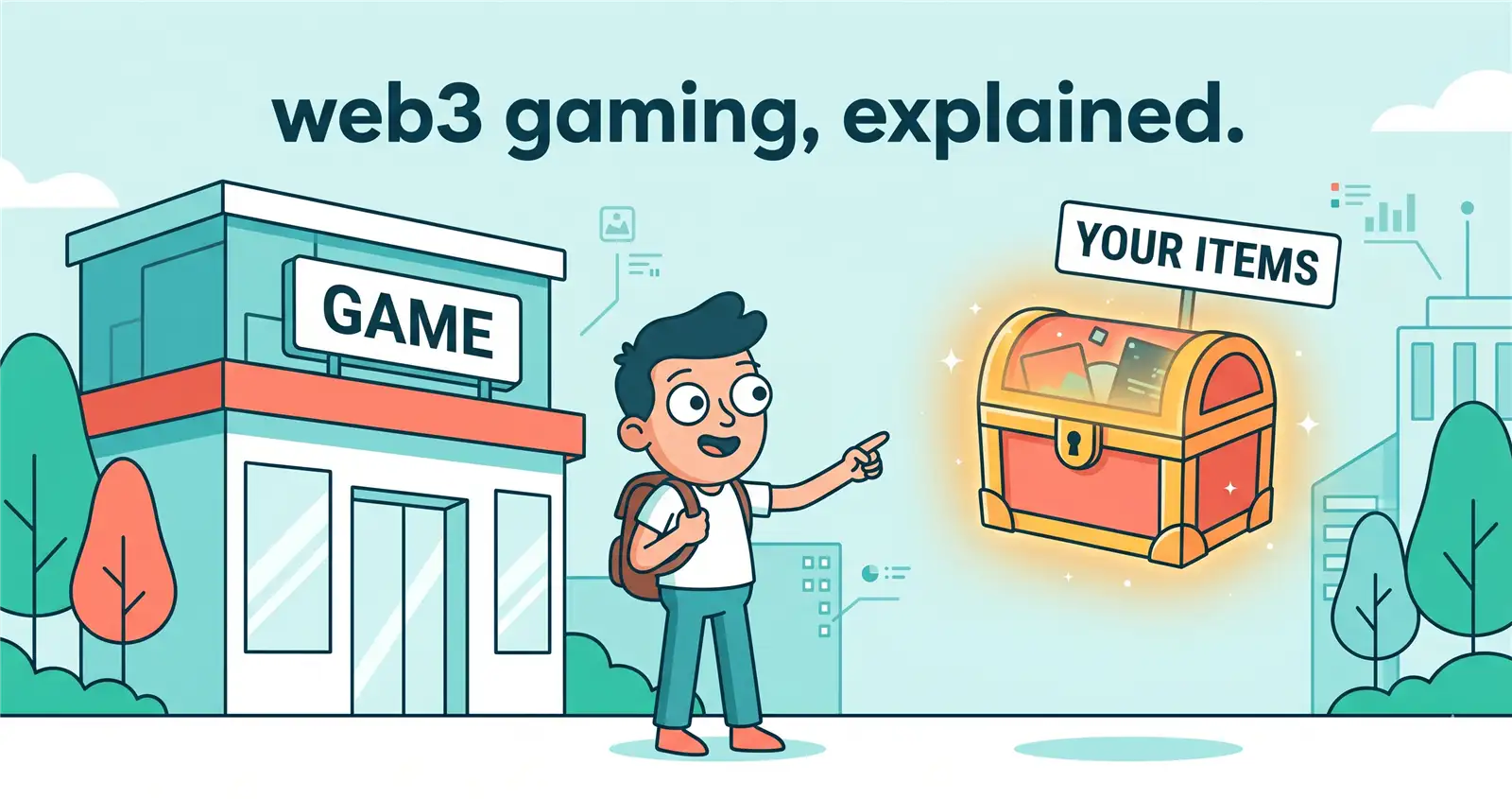
Web3 gaming is gaming where you actually own what you earn.
In a normal game, your items, skins, and currency belong to the game company. They live in the company’s database. If the game shuts down, they disappear. If you get banned, they are gone. You paid for the right to use them, not the right to keep them.
In a Web3 game, items are recorded on a blockchain. The record belongs to you, in a wallet you control. The game company cannot take it back. If the game shuts down, the item stays in your wallet. You can sell it, trade it, or hold it.
That is the core difference. Web3 gaming gives players ownership instead of a licence.
What you'll learn
- In a traditional game your items are database records the studio controls; in a Web3 game they are wallet records you control.
- Steam's EULA means you licence game assets, not own them. Web3 replaces the licence with verifiable on-chain ownership.
- When a Web3 game server shuts down your wallet assets survive; what may be lost is the game client and off-chain art metadata.
- Modern embedded wallets let players onboard with email, making blockchain mechanics invisible to those who do not want to engage with them.
The Steam comparison
Steam is the biggest traditional gaming platform. When you buy a game on Steam or earn a rare item in a Steam game, Valve technically owns those assets in their system. You have a licence to access them. You cannot sell a Steam game you bought. You cannot transfer most items outside the Steam ecosystem.
A Web3 game works differently. When you earn a rare weapon or character, the game mints it as an NFT to your wallet. You own it. You can sell it on a marketplace to another player. You can transfer it to a wallet someone else controls. If the game servers go offline, the item remains in your wallet.
Some Web3 games also let you use items across multiple games: your character from one game might work in another if both use the same asset standard.
What is an NFT in a game?
NFT stands for Non-Fungible Token. Non-fungible means non-interchangeable: each one is unique, or at least part of a limited set.
A game item as an NFT is a digital record on a blockchain that says: this specific item (sword number 4,821 out of 10,000 ever made) belongs to this wallet address. The record is public, permanent, and cannot be altered.
Not every item in a Web3 game is an NFT. Common items might be stored normally. Rare or tradeable items are more commonly minted as NFTs.
What is play-to-earn?
Play-to-earn games reward players with tokens or assets that have real-world value. Time spent playing generates something tradeable.
Early play-to-earn games in 2021 attracted massive attention. Some players in lower-income countries earned real income from them. When the token markets dropped in 2022, most of those earnings collapsed with them.
The term has evolved. Many developers now prefer “play-and-own”: games where blockchain ownership is a feature, not a promise of financial return. The distinction matters. Owning what you earn is a reasonable proposition. Being promised income from a game is a riskier one.
What do I need to play a Web3 game?
Most modern Web3 games try to remove friction from the player experience. What you need varies:
A wallet. Your wallet holds your assets. Some games manage this for you (custodial wallet): you create an account with an email and the platform handles the blockchain side. Others require a self-custody wallet like MetaMask.
Sometimes: some crypto. Some games require a small amount of cryptocurrency to start. Others are free to play, with optional purchases.
The game itself. Most Web3 games are web-based or downloadable like any other game.
The best Web3 games are designed so that new players do not have to understand blockchain to enjoy them. The technology should be invisible.
Are Web3 games any good?
Honestly: it depends on the game.
The 2021 wave produced a lot of games that prioritised token economics over gameplay. They attracted speculative players rather than gamers. Most of them failed.
The games that have survived are the ones that are worth playing regardless of the blockchain mechanics. The Web3 layer adds genuine ownership and a trading economy. It does not fix a game that is not fun to begin with.
The question to ask about any Web3 game is the same as any other game: is it worth your time? If yes, the ownership mechanics are a bonus. If no, the fact that the items are on a blockchain does not help.
Where to find Web3 games
The Web3 gaming space moves quickly. Games launch, evolve, and sometimes shut down. A few places to find what’s available:
- Gaming chains like Immutable and Ronin maintain directories of games on their platforms
- Crypto gaming news sites cover new launches regularly
- The Genesis Engine blog covers Web3 gaming news, releases, and industry analysis
For deeper background on the Web3 gaming industry (where it came from, how regulation has changed it, and what the infrastructure looks like), read the complete Web3 gaming guide.
FAQ
Is Web3 gaming the same as NFT gaming?
Mostly. NFTs are the most common technology for representing player-owned items. Not every Web3 game uses NFTs for everything, but most do for tradeable assets.
Do I have to spend money to play Web3 games?
Some require an upfront purchase. Others are free to play. Many have optional purchases. The model varies by game.
Can I lose money playing Web3 games?
If you buy assets speculatively and the value drops, yes. If you play a game you enjoy without buying assets expecting returns, you are in the same position as any other game player.
What happens to my assets if the game shuts down?
The items stay in your wallet. The game context (servers, game client, art metadata) may be gone, but the onchain record of ownership remains.
Are Web3 games regulated?
In the EU, most are or will be regulated under MiCA. That affects developers more than players. Players can still play. Studios need to be licensed to serve EU players legally.
Curious about the games available on Genesis Engine? Follow the Genesis Engine blog for Web3 gaming news and new game releases.
— Magnus
All posts