 ← Back to the blog
Play-to-Earn Games: How They Work & What to Know in 2026
Play-to-earn games are games where time spent playing generates assets or tokens with real-world value. You play. You earn things. Those things can be sold.
That is the simple version. The reality is more complicated, and in 2026 it looks quite different from what the phrase originally promised.
What you'll learn
- Axie Infinity's collapse demonstrated that economies requiring continuous new-player inflow to sustain existing players are structurally unsustainable.
- Sustainable 2026 models use token sinks, skill-gated drops, and seasonal rewards rather than pure emission-based earnings.
- Earned tokens and NFTs are taxable events in most EU jurisdictions: players must record every transaction and its value at receipt.
- Some P2E games have blocked EU players because they lack MiCA authorisation for custodial wallet or marketplace features.
How play-to-earn works
The core loop:
- You play the game: completing quests, winning battles, farming resources, breeding creatures, or building on virtual land
- The game rewards you with in-game tokens or NFT assets
- Those tokens and assets can be sold to other players or on a marketplace
- The proceeds can be converted to cryptocurrency and, eventually, to real currency
The economic logic: if a game has players who want specific items or tokens, those items and tokens have value. If you can produce them through play, you can earn from the game.
What happened in 2021
The play-to-earn boom of 2021 created enormous attention and then enormous disappointment.
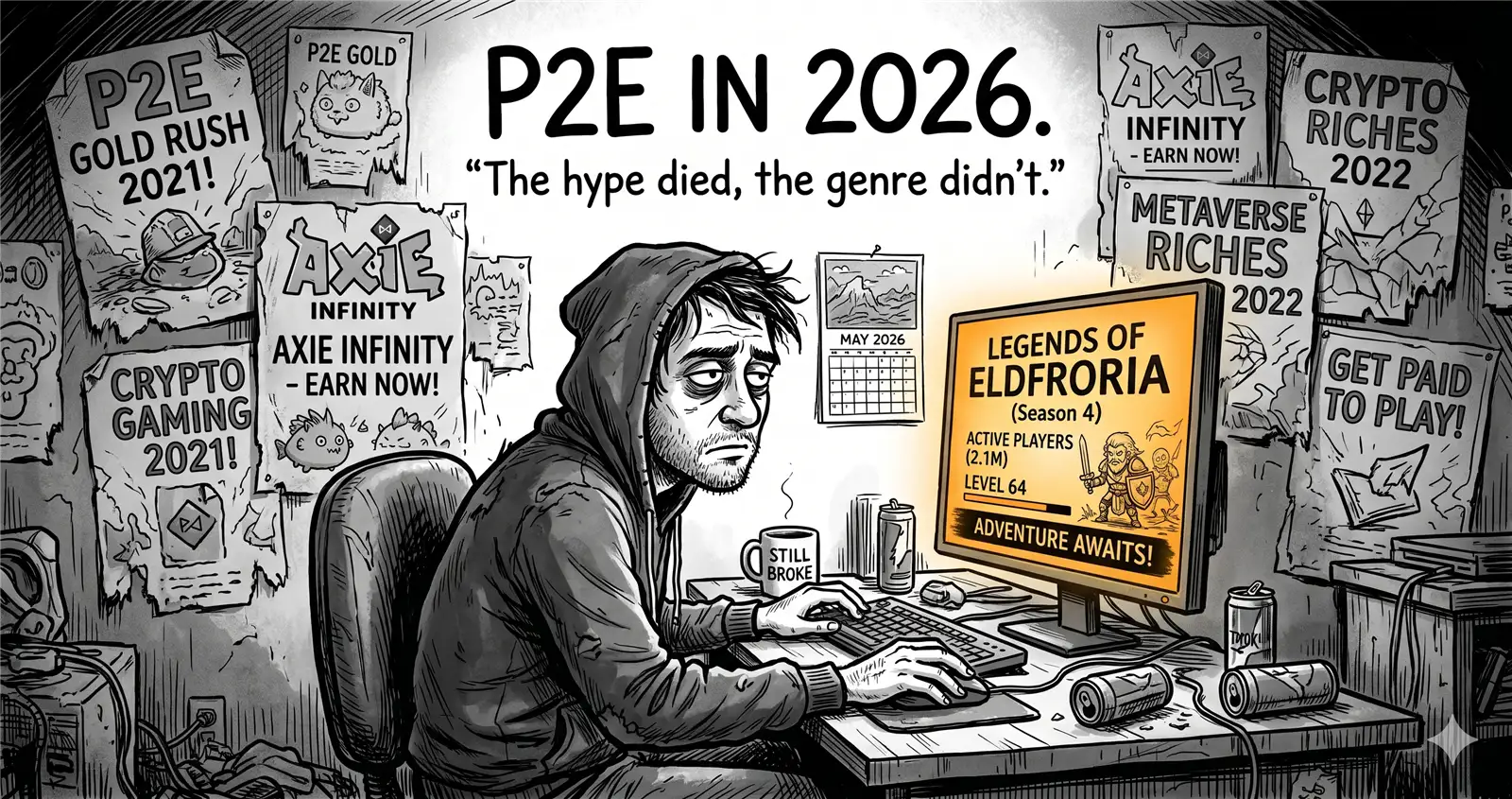
Axie Infinity was the central example. At peak, players in the Philippines and other lower-income countries were earning hundreds of dollars per month farming in the game. The tokens they earned had real value because new entrants were buying them to start playing.
The model had a fundamental problem: it required a continuous stream of new players buying in to sustain the earnings of existing players. When new player growth slowed, token values dropped. When token values dropped, earnings collapsed. By 2022, many players who had treated Axie as a primary income source found that income was gone.
This pattern repeated across dozens of play-to-earn games launched in that period.
What play-to-earn looks like in 2026
The phrase “play-to-earn” is less common now. Developers and players have learned from the collapse. It survives as one model within the broader crypto gaming landscape rather than the defining pitch.
What replaced it:
Play-and-own. You own what you earn. Assets have a secondary market. But the game is not designed around generating income. It is designed around being worth playing. The economics are a layer on top of a real game, not the game itself.
Sustainable reward structures. Games now think harder about token sinks: mechanisms that remove tokens from circulation to manage inflation. Crafting, burning, staking, and upgrade costs all reduce the circulating supply of earned tokens.
Skill-based earnings. Games that reward the best players, rather than the most time spent, are more economically sustainable. A competitive tournament with token prizes rewards performance, not just grinding.
Guild structures. Gaming guilds lend high-value assets to players who cannot afford the buy-in. The player uses the asset to earn, splits the proceeds with the guild. This spreads access but also spreads risk.
Models that still work
Not all play-to-earn failed. The models with staying power:
Limited supply, skill-gated drops. Rare items are earned through genuine achievement: ranked play, tournament victories, rare crafting combinations. Supply is controlled. The best players earn the most valuable items. Secondary markets price them accordingly.
Seasonal rewards. Fixed-length seasons with defined rewards. Players grind during the season. Rewards expire or change. New content resets the competition. This prevents any single asset from dominating the economy long-term.
Real game economies. Games with genuine gameplay loops (competitive, social, or creative) sustain economies because players are engaging for reasons beyond earning. The token economy is a layer, not the entire product.
Is play-to-earn worth your time in 2026?
The honest answer: it depends on the game.
If the game is worth playing without the economic layer, the earnings are a bonus. Competitive players in any healthy game economy will earn more than casual players. That has always been true, even in traditional games (streaming revenue, tournament prizes, boosting services). In a Web3 game, that economic participation is native and accessible to anyone.
If the game is only worth playing because of the earning potential, proceed carefully. Token economies that depend on new entrants to sustain existing players are not different in structure from unsustainable financial schemes. The collapse when growth stops is inevitable.
Questions to ask before playing a play-to-earn game:
- Would I play this if there were no tokens involved?
- Is there a maximum token supply, and what controls inflation?
- What is the token burn rate vs emission rate?
- Has the economy been running long enough to show how it behaves over time?
- Is the team named and trackable?
- Are smart contracts audited?
Taxes
In the EU and most other jurisdictions, tokens and NFTs earned in play-to-earn games are taxable. The moment you earn a token worth money, that may be income. When you sell it, any gain is potentially capital gains tax.
The specifics vary by country. This is not tax advice. If you are earning meaningful amounts from a play-to-earn game, speak to a tax professional familiar with crypto assets. Record every transaction: what you earned, when, and its value at the time.
EU players and regulation
Under MiCA, game studios running custodial wallets or marketplaces for EU players need regulatory authorisation. Some play-to-earn games have not obtained this authorisation and have blocked EU players as a result.
If you are in the EU, check whether the game you want to play is openly available to EU residents. A game that accepts EU players without any compliance framework is either working toward it, or has not addressed it.
FAQ
Can I actually make money from play-to-earn games?
Some players do. The amount varies enormously by game, skill, and timing. Players who enter early in a healthy game economy often earn more than those who enter late. The best players in competitive games earn from ranked rewards. The promise of income without skill or timing is usually not how it works out.
How much do I need to invest to start?
It varies by game. Some play-to-earn games require an upfront purchase (an NFT character, for example) to access the earning mechanics. Others have free-to-play options that earn less. Know your buy-in before committing.
Is play-to-earn different from gambling?
It depends on the game. Games where earnings depend purely on random drops or token price movements are closer to gambling in their risk profile. Games where earnings depend on skill and strategy are closer to competitive gaming. The distinction matters for both your decision-making and, in some jurisdictions, for the regulatory classification of the game.
What is a scholarship in play-to-earn gaming?
A scholarship is when a guild or individual lends a high-value game asset to a player who cannot afford the buy-in. The player uses the asset to play and earn, then splits earnings with the asset owner according to a pre-agreed ratio. This was widespread during the Axie Infinity boom.
Do I need crypto to play play-to-earn games?
Often yes, for initial purchases or transaction fees. Some games have onboarded players without requiring crypto knowledge: the game manages the wallet on your behalf. This varies significantly by game.
Are play-to-earn earnings taxed?
In most jurisdictions, yes. Tokens earned in play-to-earn games are typically treated as income at the point of receipt, and any appreciation when sold may be subject to capital gains tax. Record your transactions carefully.
Genesis Engine is building the licensed platform for Web3 games. Games on Genesis Engine can include play-to-earn mechanics with compliant payment rails for EU players. Learn more about how it works.
— Magnus
All posts